

Jaw Pain and Teeth Grinding at Night: How Sleep Position Affects TMJ Discomfort
Quick answer: Morning jaw pain is often caused by sleep bruxism (teeth grinding), nighttime jaw clenching, poor sleep posture, or a combination of all three. Changing your sleep position and using a properly supportive pillow can significantly reduce the mechanical load on the temporomandibular joint (TMJ) overnight, easing discomfort by morning.
Waking up with a stiff, aching jaw is more than just an inconvenience.
For millions of adults, it signals something happening during the hours they cannot control: muscles firing, joints compressing, and posture pulling the jaw out of alignment for hours at a time.
The culprit is not always obvious. It could be stress, sleep bruxism (teeth grinding during sleep), or something as straightforward as the way you position your head on your pillow.
This guide breaks down why jaw pain at night happens, how your bruxism sleep position plays a direct role in making it worse, and, crucially, what you can do about it without needing a medical degree to understand the answer.
Why the Jaw Joint Comes Under Strain Overnight
The temporomandibular joint, the sliding hinge that connects your jawbone to your skull, is one of the most complex joints in the human body. It facilitates up-and-down, side-to-side, and back-and-forth movement. It is estimated that people can clench their teeth with a force of up to 250lbs!
When it becomes inflamed or fatigued, the result is Temporomandibular Joint Disorder (TMD). According to a meta-analysis published via the National Institutes of Health, the global incidence of TMD is approximately 34% of the world population, a figure that underscores just how common this condition is.
At the heart of TMJ pain sleeping is a condition known as sleep bruxism. Unlike daytime clenching, which you can consciously stop, sleep bruxism is a subconscious neuromuscular activity.
As the Mayo Clinic notes,
"Sleep bruxism is considered a sleep-related movement disorder. People who clench or grind their teeth during sleep are more likely to have other sleep disorders, such as snoring and pauses in breathing."
According to a global systematic review and meta-analysis, the global prevalence of sleep bruxism is approximately 21%.
During a nocturnal grinding episode, the masseter muscle, the primary muscle used for chewing, fires repeatedly. The human jaw can exert up to 250 pounds of force during these episodes. This sustained jaw tension overnight compresses the TMJ's delicate articular disc, restricts blood flow to surrounding tissues, and floods muscles with lactic acid. The joint becomes inflamed.
By morning, you feel it.
There is also what sleep professionals call the carryover effect.
Daytime stress keeps the jaw braced for hours, during work, driving, and even while scrolling on a phone. That muscle tension does not simply disappear at bedtime. It compounds.
The result is a higher total jaw load before sleep even begins.
See also - Why Does My Back Hurt When I Wake Up? (And How to Fix It)
The Link Between Sleep Position and Bruxism
We spend roughly a third of our lives in bed.
The posture we adopt during that time has a real, compounding effect on the jaw joint. Not all bruxism sleep positions are equal.
|
Sleep Position |
Effect on TMJ |
Bruxism Risk |
|---|---|---|
|
Stomach sleeping |
Rotates cervical spine, compresses jaw joint |
High - increases clenching |
|
Side sleeping (unsupported) |
Uneven pressure on one jaw side |
Moderate - worsened by incorrect pillow height |
|
Side sleeping (well-supported) |
Maintains spinal alignment, jaw stays neutral |
Low to moderate |
|
Back sleeping (flat pillow) |
Jaw drops backward, may trigger airway reflex |
Moderate - airway-related clenching |
|
Back sleeping (cervical support) |
Neutral spine, no facial pressure |
Lowest overall |
Stomach sleeping: the worst offender
For anyone with TMJ pain sleeping concerns, stomach sleeping is universally considered the most harmful position. To breathe, you must turn your head sharply to one side. This twists the cervical spine and tightens the neck muscles that connect directly to the jaw.
The side of your face presses into the mattress or pillow, pushing the lower jawbone (mandible) out of its natural alignment. As Dr Kahn of the Cleveland Clinic explains,
"When you sleep on your stomach, your head can't rest properly on the pillow and in line with your cervical spine. Your head may be rotated or tilted... that can result in 'myofascial pain with referral' that you can feel in your jaw and the temporomandibular joints."
Back sleeping and the airway dilemma
Back sleeping removes direct facial pressure from the equation, which should theoretically allow the TMJ to rest.
However, when the airway partially collapses during sleep, common for those with mild obstructive sleep apnoea, the brain sends emergency signals to the jaw muscles. The jaw thrusts forward and clenches down to reopen the airway. This involuntary survival mechanism is one reason teeth grinding sleep episodes tend to spike in back sleepers on flat pillows.
Side sleeping: the nuanced middle ground
Side sleeping keeps the airway relatively open, reducing apnoea-triggered clenching. It is also the most common sleep position overall. The risk, for TMJ sufferers, lies in pillow height. If your pillow is too flat, your head droops downward, compressing the jaw joint on the lower side. If it is too thick, your neck bends upward, pulling neck muscles and straining the joint from above. The solution lies in proper cervical alignment, not in avoiding side sleeping altogether.
See also - Are Memory Foam Pillows Good For Neck Pain?

Positioning and Support to Ease Jaw Tension
Understanding how to find the best sleeping position for TMJ pain is one thing. Setting up your sleep environment to support it is another. As Sleep Clinic Melbourne notes,
"When your head and neck are in a neutral position, supported by a pillow, it discourages jaw clenching and teeth grinding. Ensure your neck is supported with a pillow that maintains the natural curve of your cervical spine."
The right pillow for pillow support jaw pain relief should keep the cervical spine perfectly parallel to the mattress. For side sleepers, that means filling the exact gap between your ear and shoulder. For back sleepers, it means supporting the neck's natural curve without pushing the chin toward the chest.
Here is where Putnams, handmade in Devon since 1979, offers purpose-built solutions for each sleep pattern:
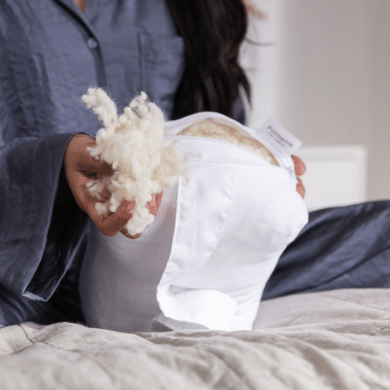
- The Putnam Pillow: Designed for both back and side sleepers, the Putnam Pillow features a built-in cervical roll that supports the neck's natural curve. Critically, it includes a dedicated ear and cheek recess for side sleepers, a contoured cutout that lifts facial weight away from the jaw, preventing the mattress from compressing the temporomandibular joint. For general TMJ pain sleeping relief, this is Putnams' most versatile option.
- The Putnam Memory Foam Pillow: Recommended by chiropractors, this pillow is specifically designed to reduce tension headaches, sore ears, and stiff necks, all common symptoms of overnight jaw tension. The memory foam contours precisely to the shape of your head and neck, maintaining neutral alignment throughout the night.
- The Facial Surgery Recovery Pillow: For those experiencing severe TMJ flare-ups or inflammation, this contoured pillow creates a gentle cradle for the back of the head while elevated side bolsters prevent rolling onto the face. Zero direct contact is placed on the mandible or cheeks, allowing inflamed joint tissues to rest in a neutral position.
- The Cervical Roll Pillow: A compact, cylindrical neck support that can be used inside a standard pillowcase or independently. Particularly useful for back sleepers who need targeted cervical support without the bulk of a full contour pillow.
- Bed Wedge Pillows: For those whose teeth grinding sleep is linked to airway restriction or snoring, elevating the upper torso at a gentle 10-15 degree incline uses gravity to keep the airway open. This directly reduces the neurological trigger to clench, making wedge pillows a valuable tool for back sleepers with mild airway issues.
The hand-under-pillow trap
One commonly overlooked habit is tucking a hand or arm beneath the pillow, directly under the face. As Dr Kahn of the Cleveland Clinic observes,
"If you use your hand to support your head under your pillow, you put tension on your jaw and push it to the opposite side."
A properly fitted cervical pillow removes the need for this entirely.
The jaw release technique
Before drifting off, practice a conscious reset of the facial muscles.
Dentists often describe the ideal resting jaw position as: lips together, teeth apart, tongue resting lightly on the roof of the mouth. Placing the tongue against the hard palate just behind the front teeth creates a natural buffer that makes it biomechanically more difficult to clench tightly during sleep.
See also - What Is The Best Pillow For Neck Pain?
Additional Steps to Reduce Overnight Jaw Tension
Sleep position and pillow support address the mechanical side of jaw tension overnight. But the full picture also includes:
- Stress management: Research published in the Journal of Clinical Medicine found a significant correlation between somatisation (the physical expression of psychological stress) and sleep bruxism. Techniques including deep breathing, progressive muscle relaxation, and reducing evening screen exposure can meaningfully lower jaw load before bed.
- Dietary habits: Limiting caffeine and alcohol in the evening helps, as both can increase muscle tension and disrupt sleep quality.
- Warm compress: Applying warmth to the jaw for 10-15 minutes before bed relaxes the masseter and temporalis muscles, reducing the tension carried into sleep.
- Custom night guard: A rigid, custom-fitted acrylic splint from a dentist keeps the jaw in a neutral position and protects tooth enamel from the extreme forces of bruxism. Over-the-counter boil-and-bite guards are far less effective and can sometimes worsen TMJ symptoms by providing a surface to actively chew against.
- Professional evaluation: If morning jaw pain at night persists, worsens, or occurs alongside symptoms such as ear pressure, jaw locking, clicking, or headaches, see a dentist or orofacial pain specialist. Symptoms that include snoring, fatigue, dry mouth, or morning headaches alongside jaw pain deserve medical evaluation for potential airway-related issues.
Wake Up Without the Ache
Morning jaw pain does not have to be part of your routine.
The relationship between your jaw and your sleep posture is a precise mechanical balance, one that gravity, pillow height, and head position influence across every hour of the night.
For many people, two changes make the most immediate difference: shifting away from stomach sleeping, and replacing a flat or unsupportive pillow with one that holds the cervical spine in neutral alignment.
Putnams' range of neck and cervical support pillows, handmade in Devon and backed by over 8,600 verified reviews, are designed precisely for this purpose, whether you sleep on your back, your side, or you are working to break a stomach-sleeping habit.
Explore the full Putnams neck pillow range and find the support that lets your jaw finally rest.
Frequently Asked Questions
Why does my jaw hurt when I wake up?
Morning jaw discomfort typically indicates that the jaw muscles were overworked overnight. The most common cause is sleep bruxism, teeth grinding or clenching that occurs during sleep, often driven by stress or triggered as an involuntary physical response to airway restriction. Sleep posture that places uneven pressure on the jaw joint can amplify the problem significantly.
What is the best sleeping position for TMJ pain?
Sleeping on your back with proper cervical support is widely considered the best sleeping position for TMJ pain. It prevents direct pressure on the facial structures and keeps the head, neck, and spine in neutral alignment. Side sleeping is an acceptable alternative, provided the pillow fills the gap between the ear and shoulder correctly and the jaw does not rest directly against the pillow surface.
Is side sleeping bad for your jaw?
Side sleeping is not inherently harmful, but it can worsen TMJ pain sleeping if the jaw rests under direct pressure or the pillow height is wrong. A contoured cervical pillow that keeps the neck aligned, such as the Putnam Pillow , can make side sleeping comfortable for TMJ sufferers by lifting facial weight away from the joint.
Why is TMJ pain worse at night?
During the day, you can consciously relax your jaw. At night, unconscious muscle contractions take over. The body may clench or grind as a reflex response to airway restriction or subconscious stress, leading to sustained joint pressure and inflammation. Poor sleep quality and fragmented sleep can further increase this activity.
How can I stop grinding my teeth in my sleep?
Managing teeth grinding sleep involves a combination of physical and behavioural approaches: wearing a custom-fitted night guard, practising stress-reduction techniques, limiting caffeine and alcohol before bed, performing daily jaw-release exercises, and optimising sleep position with cervical pillow support.
Does sleep apnoea cause teeth grinding?
There is a well-documented link (SleepApnea). When the airway partially collapses and oxygen levels drop during sleep, the brain signals the jaw to thrust forward and clench, forcefully reopening the airway. Elevating the upper torso with a wedge pillow or using a properly supportive cervical pillow can help keep the airway open and reduce this trigger.
Can my pillow make TMJ pain worse?
Yes.
A pillow that is too high or too flat forces the neck out of neutral alignment, adding sustained muscular tension and rotational pressure to the jaw joint. The wrong pillow does not cause TMD (temporomandibular disorder), but it can significantly aggravate an existing condition, sometimes enough to make the difference between waking refreshed and waking in pain.
Do mouth guards actually help with morning jaw pain?
A custom-fitted night guard from a dentist creates a protective barrier between the upper and lower teeth, absorbing the intense forces of grinding and easing strain on the jaw muscles. It can reduce headaches and facial discomfort associated with TMD. That said, a mouth guard addresses the teeth, not the sleep posture or cervical alignment that may be driving the underlying muscle tension.


Du blog
Voir toutes




Laissez un commentaire