

Les réveils lumineux peuvent-ils améliorer votre cycle de sommeil ? Une meilleure façon de se réveiller ?
Réponse rapide : les réveils simulateurs d'aube fonctionnent en éclaircissant progressivement votre chambre avant l'heure du réveil, réduisant ainsi l'inertie du sommeil et soutenant votre rythme circadien. La recherche confirme qu'ils diminuent de manière significative l'état de somnolence matinale et sont particulièrement efficaces pour les matins d'hiver et le trouble affectif saisonnier (TAS). Pour de meilleurs résultats, positionnez la lampe à 45-60 cm de votre visage et associez-la à un environnement de sommeil confortable et propice.
La plupart des gens connaissent cette sensation : le réveil sonne à 6 heures du matin dans une pièce plongée dans l'obscurité, votre cœur s'emballe et vous passez l'heure suivante à vous traîner dans un brouillard. Cette sensation lente et lourde, cliniquement connue sous le nom d'inertie du sommeil, n'est pas seulement désagréable. C'est un signe que votre corps a été brusquement tiré du sommeil avant qu'il ne soit biologiquement prêt.
C'est là qu'intervient un réveil simulateur d'aube.
Également appelés lampes de réveil ou réveils de luminothérapie, ces appareils remplissent progressivement votre chambre de lumière sur une période de 20 à 90 minutes avant l'heure de votre réveil, imitant une aube naturelle et donnant à votre corps le signal chimique doux dont il a besoin pour passer du sommeil à l'éveil.
La différence, pour beaucoup de gens, est frappante.
Mais les réveils simulateurs d'aube améliorent-ils le sommeil d'une manière significative et scientifiquement prouvée ? Ou sont-ils un ornement de chevet coûteux ? Les preuves sont plus convaincantes que vous ne l'imaginez.
Comment votre rythme circadien contrôle-t-il le sommeil et l'éveil ?
Votre corps fonctionne selon un horaire biologique de 24 heures appelé votre rythme circadien.
Cette horloge interne régule tout, de la digestion et de la température corporelle à votre cycle veille-sommeil, et elle tire son indice le plus puissant d'une seule chose : la lumière.
Des cellules spécialisées sensibles à la lumière dans vos yeux, appelées cellules ganglionnaires rétiniennes intrinsèquement photosensibles (ipRGC), transmettent des signaux directement au noyau suprachiasmatique (NSC) du cerveau, essentiellement le stimulateur cardiaque principal de votre horloge biologique. Lorsque l'obscurité tombe, le NSC déclenche la libération de mélatonine par la glande pinéale, l'hormone qui vous rend somnolent. Lorsque la lumière arrive le matin, la production de mélatonine diminue et le cortisol augmente dans ce que l'on appelle la réponse d'éveil du cortisol (CAR), un pic sain qui prépare votre énergie, votre fonction immunitaire et vos performances cognitives pour la journée.
Le problème avec un réveil standard est qu'il contourne complètement ce processus. Réveillé à 6 heures du matin dans une pièce sombre, votre mélatonine est toujours élevée et votre cortisol n'a pas eu la chance d'augmenter naturellement. Votre corps est physiquement éveillé, mais chimiquement, il est toujours en mode sommeil.
Le résultat est cette sensation de somnolence et de désorientation qui peut persister pendant la première heure de votre journée.
C'est particulièrement prononcé pendant les jours plus courts de l'automne et de l'hiver, lorsque les matins plus sombres signifient que la mélatonine reste élevée plus longtemps, l'une des raisons pour lesquelles tant de gens trouvent qu'il est beaucoup plus difficile de sortir du lit d'octobre à mars.

Comment fonctionnent les réveils simulateurs d'aube ?
Une horloge simulateur d'aube commence son cycle lumineux 20 à 90 minutes avant votre réveil.
Elle commence par une lueur ambrée ou rouge douce et chaude, le genre de longueurs d'onde qui passent le plus facilement à travers les paupières fermées, et augmente progressivement en luminosité, atteignant finalement 200 à 300 lux comme le ferait une aube naturelle.
Voici un détail que la plupart des gens trouvent surprenant : vos paupières ne sont pas des rideaux occultants. Des recherches publiées dans le Journal of Biomedical Optics (Bierman, Figueiro & Rea, 2011) ont montré que les paupières bloquent environ 99 % de la lumière visible en moyenne, mais qu'elles bloquent les longueurs d'onde bleues beaucoup plus efficacement que les rouges et les oranges chauds. Une lampe d'aube chaude de 2700K fournit en fait un signal plus utilisable à votre rythme circadien à travers les paupières fermées qu'une lumière bleue froide, car le bleu est largement filtré avant d'atteindre les cellules importantes.
Alors que cette lumière chaude pénètre lentement vos paupières, elle atteint la rétine et envoie un signal silencieux mais puissant au NSC. La suppression de la mélatonine commence avant même que vous ne soyez conscient. Au moment où la lumière atteint sa luminosité maximale, votre corps a déjà commencé la transition naturelle vers l'éveil. Le simulateur d'aube vous surprend dans un stade de sommeil plus léger, de sorte que lorsque vous ouvrez les yeux, vous vous sentez beaucoup plus prêt à être éveillé.
Voir aussi - Comment le trouble affectif saisonnier (TAS) affecte le sommeil et conseils pour un meilleur repos
Les simulateurs d'aube améliorent-ils réellement le sommeil ? Ce que la recherche montre
Les réveils simulateurs d'aube en valent-ils la peine ? Les preuves cliniques disent oui, en particulier pour deux choses : la réduction de la somnolence matinale et la gestion des changements d'humeur liés à l'hiver.
|
Bénéfice revendiqué |
Force des preuves |
|---|---|
|
Moins d'inertie du sommeil / réduction de la somnolence matinale |
Forte régulièrement répliquée |
|
Transition plus douce du sommeil à l'éveil |
Forte |
|
Soulagement des symptômes du TAS en hiver |
Forte niveau d'essai clinique |
|
Décalage de l'horloge biologique plus tôt (lève-tard) |
Modérée réel mais effet modeste |
|
Stimulation de l'éveil du cortisol |
Mitigée certaines études montrent un effet, d'autres non |
|
Gains objectifs en performances cognitives |
Faible principalement chez les personnes privées de sommeil |
Une étude croisée de 2010 dans le Journal of Sleep Research (Van de Werken et al.) a révélé qu'une aube artificielle de 30 minutes avant l'heure du réveil réduisait considérablement la somnolence subjective et augmentait la vigilance par rapport à l'allumage des lumières au moment du réveil. Une étude de 2014 par Thompson et al. dans le European Journal of Applied Physiology, menée spécifiquement sur des personnes ayant l'habitude de se réveiller difficilement, a trouvé le même résultat : une meilleure qualité de sommeil perçue et une vigilance mesurablement améliorée pendant les 75 premières minutes de l'éveil.
Pour ceux qui luttent contre la déprime hivernale, les preuves sont encore plus solides.
Dans un essai clinique de 2001 sur 95 patients atteints de TAS sans médicaments (Avery et al., Biological Psychiatry), la simulation d'aube a surpassé un placebo à lumière tamisée et une lampe de luminothérapie de 10 000 lux en termes de taux de rémission et de réponse. Une méta-analyse ultérieure de 2005 (Golden et al., American Journal of Psychiatry) a estimé la taille de l'effet de la simulation d'aube pour le TAS à 0,73, un résultat cliniquement significatif, comparable à la luminothérapie et listée comme un traitement de première ligne par l'American Psychiatric Association.
Trouver le meilleur réveil simulateur d'aube pour les matins d'hiver n'est pas seulement une décision de confort ; cela a de véritables implications pour l'humeur et la santé mentale pendant les mois les plus sombres.
Une note pratique importante : les études citées ci-dessus utilisent environ 250-300 lux mesurés au niveau des yeux. Cela signifie que le placement est extrêmement important. Des recherches menées sur le Lumie Bodyclock Shine 300 ont montré qu'à 45 cm du visage, la lampe délivre environ 362 lux (au-dessus de la cible de l'étude) ; à 90 cm, cela tombe à seulement 110 lux, bien en dessous de ce qui est nécessaire pour un effet biologique.
Placez votre lampe sur votre table de chevet, à 45–60 cm de votre visage, et non de l'autre côté de la pièce.

Qui bénéficie le plus d'un réveil simulateur d'aube ?
Presque toutes les personnes qui ont des difficultés le matin peuvent en bénéficier, mais certains groupes sont susceptibles de remarquer la plus grande différence :
- Les personnes souffrant de déprime hivernale ou de TAS : Les matins plus sombres suppriment l'élimination naturelle de la mélatonine. Un simulateur d'aube naturel compense le manque d'aube réelle, fournissant le signal lumineux que votre horloge biologique attend. C'est le cas d'utilisation le plus solidement étayé par la recherche.
- Couche-tard et travailleurs postés : Un essai sur le terrain de 3 semaines par Terman & Terman (2010, Journal of Biological Rhythms) a révélé qu'une aube artificielle de 90 minutes avançait le début de la mélatonine de l'horloge biologique d'environ 30 minutes, un effet comparable à 30 minutes de luminothérapie à 10 000 lux. Cela ne modifiera pas votre rythme du jour au lendemain, mais une utilisation prolongée produit une avancée significative et progressive.
- Ceux qui repoussent constamment le réveil : Si vous réglez systématiquement quatre alarmes et vous sentez toujours mal, un réveil simulateur d'aube vous fait passer progressivement à des stades de sommeil plus légers avant que votre alarme ne sonne. Revenir au sommeil profond après une sieste devient beaucoup plus difficile une fois que la lumière augmente depuis 30 à 60 minutes.
- Toute personne se réveillant dans l'obscurité : Que ce soit en raison d'un quart tôt, d'un hiver britannique ou de rideaux occultants, si votre réveil sonne dans l'obscurité, votre biologie est entièrement contournée. Un réveil lumineux restaure ce qui manque.
Voir aussi - Le bruit blanc vous aide-t-il à dormir ? Exploration des preuves derrière les sons du sommeil
Combiner de meilleurs réveils avec un meilleur confort de sommeil
Un réveil simulateur d'aube optimise votre façon de vous réveiller. Mais la qualité de votre sommeil est tout aussi importante, et de meilleures matinées commencent véritablement la veille au soir.
Même le meilleur réveil de luminothérapie ne peut pas annuler les effets d'un sommeil chroniquement insuffisant. Regarder un écran lumineux jusqu'à minuit perturbe votre NSQ, supprime la mélatonine du soir et signifie que vous cherchez cette heure supplémentaire le matin dont votre corps ressent toujours le besoin.
Quelques étapes pratiques font une différence significative :
- Assombrissez votre environnement après 21h. Remplacez les plafonniers par des lampes chaudes et de faible intensité. La lumière bleue des écrans et des ampoules LED retarde la libération de mélatonine et repousse votre fenêtre de sommeil.
- Positionnez correctement votre lampe simulateur d'aube. À 45-60 cm de votre visage sur votre table de chevet, pas sur une commode de l'autre côté de la pièce.
- Réglez une alarme audio douce en guise de sécurité. La plupart des appareils de qualité incluent des sons de la nature doux ou des carillons qui s'activent à la fin de la rampe lumineuse. Utilisez-les ; ils éliminent l'anxiété de dormir à travers la lumière.
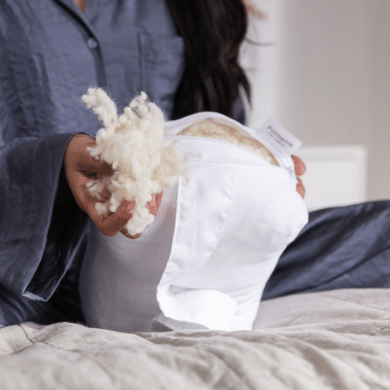
- Investissez dans un soutien de sommeil approprié. La surface sur laquelle vous dormez est importante. La gamme d'oreillers de soutien de Putnams, y compris l'Oreiller en écales de sarrasin biologique et l'Oreiller en laine britannique sont fabriqués à la main dans le Devon en utilisant des matériaux naturels et respirants qui aident à réguler la température pendant la nuit. Un bon alignement de la colonne vertébrale signifie moins de perturbations, des stades de sommeil plus réparateurs et un corps qui réagit bien mieux à ce doux signal lumineux matinal.
- Gardez votre chambre fraîche et sombre pendant la nuit. Des températures plus fraîches favorisent la libération de mélatonine ; l'obscurité pendant le sommeil empêche une perturbation circadienne prématurée.
La combinaison d'un réveil simulateur d'aube de qualité et d'un confort de sommeil véritablement de soutien, le bon oreiller, une couette respirante et une chambre fraîche crée les conditions où s'endormir et se réveiller semblent beaucoup plus naturels.
Voir aussi - Couvertures lestées pour le sommeil : Réduisent-elles vraiment l'anxiété et améliorent-elles le repos ?
Les limites honnêtes à connaître
Une bonne science signifie reconnaître là où les preuves sont minces :
- Il ne réparera pas une horloge gravement perturbée du jour au lendemain. Quelques semaines d'utilisation constante sont généralement nécessaires avant que l'effet circadien ne devienne fiable.
- Il peut vous réveiller plus tôt que prévu. Les dormeurs légers peuvent se réveiller avant l'heure prévue si la lampe est lumineuse et que la rampe commence tôt. Laissez une marge et utilisez l'alarme audio de secours.
- Il peut déranger un partenaire. Une considération réelle si vous partagez un lit avec quelqu'un ayant un emploi du temps différent (mais une alarme traditionnelle le peut aussi).
- Les applications téléphoniques ne sont pas un substitut adéquat. Un écran de téléphone orienté vers vous ne délivre qu'environ 50 lux au mieux, une fraction des 250 à 300 lux nécessaires pour produire une véritable réponse biologique. Une lampe dédiée est essentielle.
Mieux vous réveiller, dès ce soir
La façon dont vous vous réveillez donne le ton, biologiquement, hormonalement et émotionnellement, à tout ce qui suit. Un réveil simulateur d'aube agit avec la chimie de votre corps plutôt que contre elle, et la recherche pour étayer l'affirmation principale (moins de somnolence, un réveil plus doux) est réellement solide.
Le tableau complet, cependant, va au-delà de la lampe sur votre table de chevet. Ce sur quoi vous dormez, comment vous vous détendez le soir et à quel point votre environnement de sommeil favorise un repos profond, tout cela façonne l'efficacité avec laquelle votre corps réagit à cette lumière matinale progressive.
Découvrez notre gamme de produits de sommeil naturels et de soutien fabriqués à la main dans le Devon et approuvés par plus de 500 000 clients, pour construire le type de fondation de sommeil qui rend chaque matin plus facile.
Foire aux questions sur les réveils simulateurs d'aube
Les réveils simulateurs d'aube améliorent-ils réellement la qualité de votre sommeil ?
Les réveils simulateurs d'aube améliorent la qualité de votre réveil plus que le sommeil lui-même. La recherche clinique montre constamment qu'ils réduisent l'inertie du sommeil, la sensation de brouillard dans les 30 premières minutes après le réveil, et augmentent la vigilance subjective. Ils n'ajoutent pas d'heures de sommeil, mais ils rendent le sommeil que vous obtenez plus réparateur en favorisant une transition naturelle et biologiquement alignée vers l'éveil.
À quelle distance de votre visage un réveil simulateur d'aube doit-il être placé ?
Pour correspondre à l'intensité lumineuse utilisée dans les études cliniques (250-300 lux), votre lampe doit être placée à 45-60 cm de votre visage, généralement sur une table de chevet à hauteur des yeux. À 90 cm, les appareils testés ne délivrent que 110 lux, bien en dessous du seuil nécessaire pour produire un effet circadien significatif.
Les réveils simulateurs d'aube en valent-ils la peine pour les matins d'hiver spécifiquement ?
Oui, c'est en fait le cas d'utilisation le plus solide dans la recherche. En hiver, les matins plus sombres signifient que la mélatonine reste élevée plus longtemps, ce qui rend le réveil plus difficile et l'humeur plus basse. Un essai de 2001 sur 95 patients atteints de TAS a révélé que la simulation d'aube surpassait une boîte lumineuse de 10 000 lux en termes de taux de rémission. Pour quiconque lutte contre les matins sombres au Royaume-Uni entre octobre et mars, un réveil simulateur d'aube est un outil particulièrement étayé par des preuves.
Combien de temps faut-il pour qu'un réveil simulateur d'aube fasse effet ?
La plupart des gens remarquent une différence dans les premiers jours, en particulier une réduction de la somnolence et un début de matinée plus doux. Pour les effets de décalage de phase du rythme circadien (tels que le décalage de votre horloge biologique plus tôt), la recherche suggère de prévoir 2 à 3 semaines d'utilisation quotidienne constante avant de s'attendre à un changement mesurable.
Une application téléphonique peut-elle remplacer un réveil simulateur d'aube dédié ?
Non. Un écran de téléphone positionné vers vous délivre environ 50 lux, bien en dessous des 250 à 300 lux nécessaires pour pénétrer les paupières fermées et produire une réponse biologique. Un réveil lumineux naturel avec une lampe dédiée est nécessaire. Les applications d'aube sur téléphone offrent une expérience sonore plus douce mais ne peuvent pas reproduire le mécanisme physiologique d'un véritable appareil de simulation d'aube.
Un réveil simulateur d'aube est-il meilleur qu'une alarme standard pour les gros dormeurs ?
Pour la plupart des gros dormeurs, oui.
Parce qu'un réveil simulateur d'aube vous fait passer progressivement à des stades de sommeil plus légers sur 30 à 60 minutes avant que votre alarme ne sonne, il est beaucoup plus difficile de retomber dans un sommeil profond lorsque l'alarme sonore s'active. Revenir à un sommeil à ondes lentes réparateur après que la lumière se soit intensifiée pendant une heure est biologiquement difficile, ce qui est précisément le but.


Du blog
Voir toutes



Laissez un commentaire